
An Excessive Servitude
American Democracy Dismantled

Nimiaque illa libertas et populis et privatis in nimiam servitutem cadit
This excessive liberty soon brings the people, collectively and individually, to an excessive servitude. - Cicero, De Re Publica, 1.68
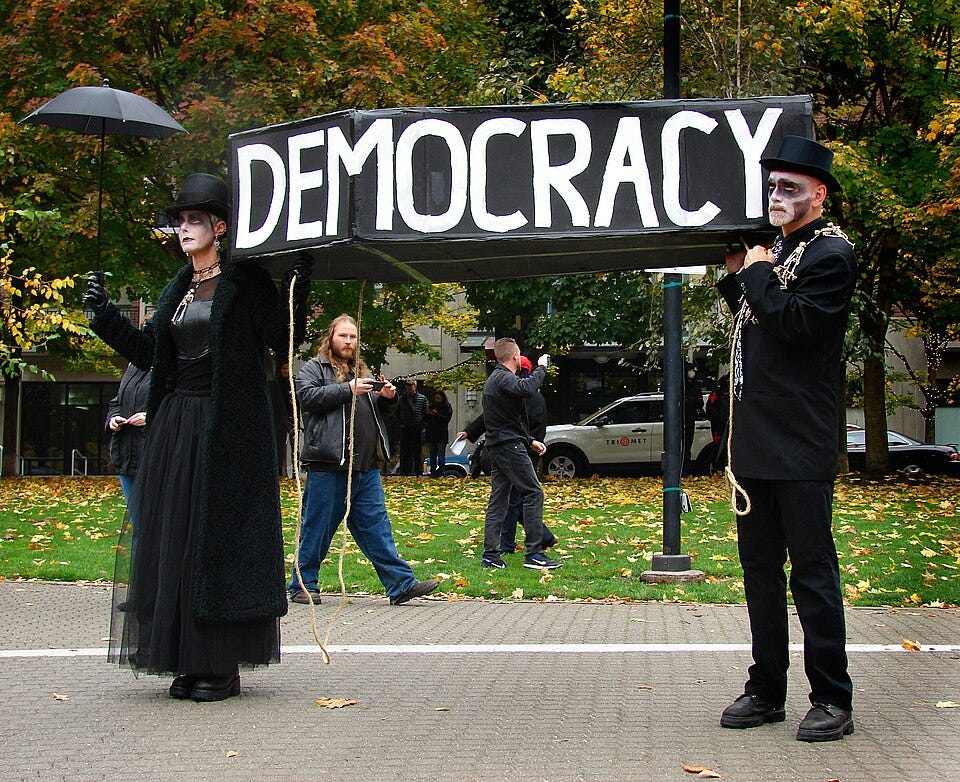
Three concepts, ideas even, contribute together towards a healthy democracy. Representatives of districts that reflect the people who live in them. A civil society that mediates between the government and the governed. A rule of law that binds the powerful and the powerless equally. The United States lost all three. These words are not a warning about what might come next. Instead, it is an account of what already occurred. Starting with this introduction, the next three contributions to the Professor attempt to explain each pillar, why it fell, and what the collapse likes like in everyday life. What comes next for a country that no longer meets the conditions of what a liberal democracy claims to be? When my students first asked me in a Disaster Governance class, during a discussion about FEMA, I did not know. Today, in light of the dismantling of the Voting Rights Act, I look at the Troubles in Ireland and Balkanization after the collapse of the Soviet Union. Indeed, I believe it’s already starting as politically motivated violence, state violence, and domestic terrorism begin to establish themselves as the new norm.
Early in graduate school, my professor Dr. Sandberg said something I have repeated every quarter (or semester depending on the institution) to students in my classroom. The market is not infallible. If it were, we wouldn’t need to correct for market failures. It is a simple observation, researched heavily in political science and public administration through a long tradition beginning with Lester Salamon.1 Those words Dr. Sandberg offered our class reshaped how I came to understand institutions that fill the gaps markets, and governments, leave behind. The nonprofit organizations, the advocacy coalitions, grassroots movements and third spaces. Over time, I came to apply similar logic to government itself.
Government is not infallible. We flawed creatures build systems of contemporary governance precisely to correct for errors of judgment, foresight, or empathy. But government, and governance, both require our astute observation of their workings. An active citizenry educated in the ideas, myths, and functions of government. An active citizenry capable of empathy across differences. An active citizenry that believes in, and upholds, the rule of law well enough to hobble along a oath pointing, however circuitous, towards a more perfect union. In the United States all three of these conditions have collapsed.
The authoritarian turn in the United States took 40 years to reach this moment. The battlefield of that struggle occurred in media and leisure spaces. In state institutions. In schools, libraries, and election offices. Indeed, Americans suffer a polarization so entrenched that politically motivated violence is both believed and observed to be increasing.2 Americans are beginning to hate one other, making choices that separate them and their families along ideological lines.3 American homes are battlegrounds. American non-profits are hamstrung. For most of American life, the federal government’s two hundred-plus agencies worked in the background, noticed only when something went wrong. Now the disruption is the routine. Americans are leaving in record numbers.4 They are increasing their personal training and stockpiling of firearms. US citizens were killed protesting policy or simply driving in the wrong place at the wrong time. Protests erupted around the country, with little to no effect on the grander politics of today.
Pundits and researchers have given this moment many different labels. Right-wing populism. Authoritarianism. Dictatorship. My own preference is the term kleptocracy. The labels matter less right now that what is, by many accounts, happening quickly. American governance, civil society, and public well-being are wrecked, likely never to recover from this moment. I am not an American optimist anymore, and Americans now face unprecedented peril. The three essays that follow this, released bi-weekly, covers these topics and explains them grounded in research, analysis, and informed observation.
The first discusses, perhaps, America’s most ancient of problems. The Gerrymander. As early as 1787, but catalyzed in the American psyche by Governor Gerry of Massachusetts in 1812, the gerrymander, “has been a source of much trouble to the lovers of political liberty. The anti-Federalists, during their temporary ascendancy at that time, established a precedent which has been as a shining mark for every political trickster in the land down to this day.”5 Louisiana v. Callais is, “the culmination of decades of its rulings limiting the Voting Rights Act. No one, including the court’s majority, disputes the impact of the decision.”6 Gerrymandering is now a honed weapon for disenfranchisement as politicians race to revoke representation and replace it with domination.
The second essay covers the assault on civil society. Civil Society are those non-governmental spaces such as our advocacy coalitions, community nonprofits, religious institutions, that help maintain a bridge between governments and its people. They not only support informed and active citizens, but they serve to correct failures in the market and overcome failures of government. They are increasingly under threat through censorship, funding debacles, and staffing challenges that have rippled across the United States as federal grant making power evaporated.
The third essay discusses a citizenry that no longer trusts in or supports the rule of law. The rule of law is the principle that all individuals, institutions, and government entities are accountable to laws that are publicly known, equally enforced, and independently adjudicated. No one is above the law, including those who make and enforce it. Laws govern society, authority is derived from them, and the same rules apply to all fairly and clearly. It is a nebulous set of interactions that, together, generate faith in equitable access to jurisprudence and recourse against governments, corporations, and private citizens. To say it is on life support would be incorrect. The rule of law in America is dead, and Thomas Paine’s sensible cry to avoid a king and absolutism has died with it.
The first essay in this series, on the Gerrymander, hits your inbox in two weeks. Until then, I welcome your comments and ideas. Please stay safe and informed.
-Andrew, The Professor
Salamon, L. M. (1987). Of market failure, voluntary failure, and third-party government: Toward a theory of government-nonprofit relations in the modern welfare state. Journal of Voluntary Action Research, 16(1-2), 29-49.
Copeland, J., & Kiley, J. (2025, October 23). Americans say politically motivated violence is increasing, and they see many reasons why. Pew Research Center. https://www.pewresearch.org/short-reads/2025/10/23/americans-say-politically-motivated-violence-is-increasing-and-they-see-many-reasons-why/
McCarty, N. (2019). Polarization: What everyone needs to know. Oxford University Press.
Hinshaw, D., & Parkinson, J. (2026, February 25). Americans are leaving the U.S. in record numbers. The Wall Street Journal. https://www.wsj.com/us-news/americans-leaving-the-us-migration-a5795bfa
The slaying of the gerrymander. (1892, May). The Atlantic.
Chemerinsky, E. (2026, May 6). Understanding the recent Voting Rights Act case. SCOTUSblog. https://www.scotusblog.com/2026/05/understanding-the-recent-voting-rights-act-case/