
We Keep Building Systems but Not Learning to Change

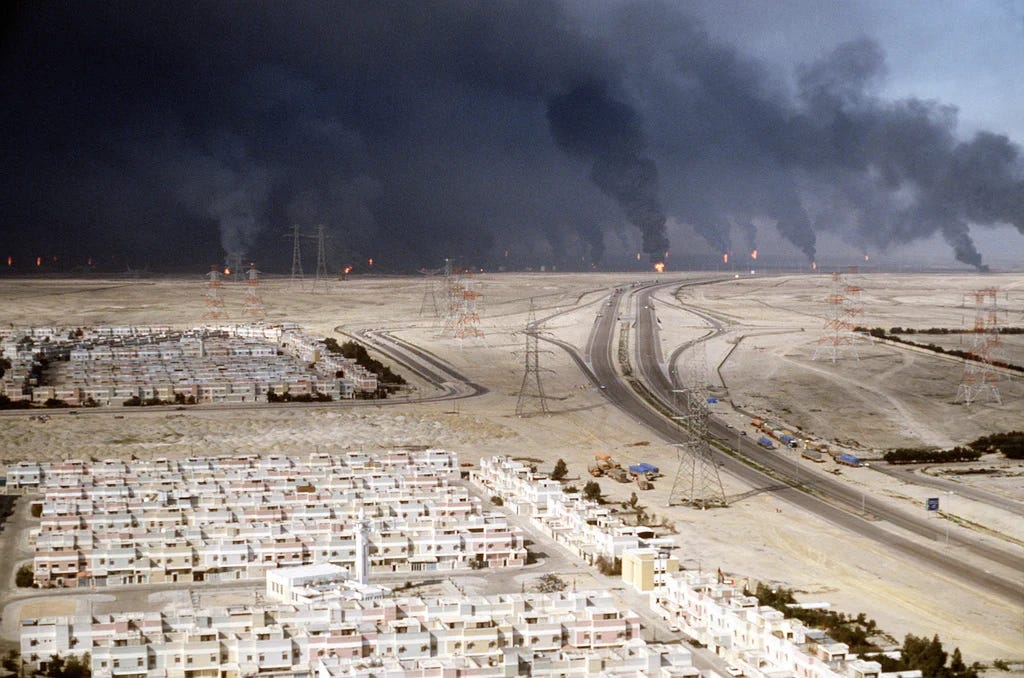
As black rain fell on Tehran this weekend and toxic smoke from bombed oil depots blanketed a city of ten million, I found myself reflecting on cases I’ve taught in the classroom about our response to such insane and purposeful environmental degradation and the ripple effects on the world. After every major disaster the same promise gets made: we will learn from this. We will study what went wrong, fix the systems that failed, and do better next time. It is a reasonable promise. Disasters generate enormous amounts of information about what works, what does not, and what needs to change. One of the most challenging problems today remains that almost none of that information reaches the people with authority to act on it. Not because it does not exist, but because it gets quietly transformed into something else on the way up the information sharing ladder. The very organizations that are tasked with responding are influenced by a lack of real, unfiltered, information that results in inaction. We all suffer as a result. I’ll discuss my insights from research on practice on this topic briefly today, Then I will provide actionable insights to counter this problem now.
How information can transform
Every disaster is supposed to teach us something. The organizations that make response possible are the same ones ensuring the lessons never get applied. I spent two years studying how information actually reaches the top. It often does, just in curated and heavily filtered snippets that are less than actionable. That is putting it mildly. Why this happens and is not easy to untangle. In fact, I would be lying if I were to claim I fully understood the process, but I call what I observed a “knowledge levee.” Like a physical levee controls water, organizational structures control what information flows through institutions, in what form, and at what volume. For instance, a nonprofit failing to setup shelters appropriately may not be acting in bad faith. Instead, it is acting on curated complaints and praise, funding constraints, and past system deployments to inform itself today. It will review reports, translate them into emails, and quantify experiences of shelter users into data points to maintain relationships with funding agencies. All while trying to keep a foot in the door of the community they are serving. Such a nonprofit uses training, standard operating procedures, and even email language to translate between those two worlds that could not speak directly to each other without the interaction breaking down. The result was that the agencies evaluating response effectiveness and EDs leading their organizations were operating on a version of reality that had been systematically stripped of its most critical feedback.
Let me use a case of a “Local Residence Card” system created in the wake of problems with FEMA applications. Homes that lost two-thirds of their structure but were not “burnt to the ground” received no assistance. So locals joined together to create their own tracking system to show relief agencies and support one another. The card system worked. It identified 290 of 300 affected families within 60 days. But the reason it was necessary, the fundamental inadequacy of federal classification frameworks, was never communicated to the agencies whose frameworks had failed. The workaround was presented as a technical innovation rather than evidence of a systemic problem. State agencies and Executive Directors (your CEO of a nonprofit, so-to-speak) never learned what they needed to learn. The feedback that would have driven reform was absorbed, reframed, or rerouted before it arrived.
This matters now as environmental catastrophe and war again erupt in the middle east. As the conflict between the U.S., Israel, and Iran enters its second week, the environmental and humanitarian toll is escalating in ways that will eventually require exactly the kind of disaster response my research examined. Oil depot strikes in Tehran have released toxic hydrocarbons, sulfur, and nitrogen oxides over a city of nearly ten million people. Residents have reported black, oil-saturated rainfall. The Iranian Red Crescent has warned of acid rain. Across the Gulf, drone strikes and missiles have hit refineries in Saudi Arabia, LNG facilities in Qatar, and desalination plants in Bahrain, infrastructure that millions of people depend on for fuel and drinking water. Oil has leaked into streets and waterways. Tanker attacks in the Strait of Hormuz have created spill risks across one of the most ecologically sensitive maritime corridors on the planet. When the fighting eventually stops, the recovery process will begin. And if past practice holds, it will follow the same pattern:
Humanitarian organizations will step into the space between affected populations and international agencies. They will filter information. They will convert grief into grant categories. They will translate political outrage into technical requests. They will absorb the worst of what people are feeling so that coordination can function.
And the people deciding how to allocate reconstruction funding, how to address environmental contamination, how to reform response systems will be working with information that has been quietly cleaned of exactly the feedback they need most. The lessons this disaster could teach will be lost the same way they were lost in dozens of efforts before. Indeed, each time, the systems get more sophisticated. The data collection improves. The coordination platforms get better. And the filtering gets more efficient too, which means the gap between what decision-makers see and what is actually happening grows wider even as our tools for measurement improve.
So what would actual change require?
Three things, none of them easy.
First, emergency managers and international agencies need to accept that they receive filtered information as a structural default, not as an occasional failure. Every report from an intermediary organization has passed through a process that serves multiple, sometimes conflicting purposes. Supplementary feedback channels, direct community listening sessions, anonymous reporting mechanisms, third-party assessments that bypass organizational intermediaries, should be built into response frameworks from the start.
Second, the funding structures that force community organizations to reshape their work into bureaucratic categories need reform. When a nonprofit has to, as one leader in my research put it, “articulate what we do so we can get reimbursed,” the articulation requirement itself produces filtering. Organizations convert responsive, community-centered work into fundable categories, and in doing so, strip out the information that does not fit those categories. The information lost in that conversion is often the information most needed for systemic improvement.
Third, and most fundamentally, political critique from disaster-affected communities needs to be treated as important and meaning-making rather than noise to be managed. When someone says a system is designed to wear them down, that is an evaluation of system design. When someone says a process is dehumanizing, that is a program assessment. Converting those statements into “eligibility concerns” keeps the coordination machinery running, but ensures the machinery never improves.
We have gotten very good at responding to disasters. We have not gotten good at learning from them. The organizations that make response possible are, by the very nature of their position, the organizations that prevent the hardest truths from reaching the people who need to hear them. That is not a problem of bad actors. It is a problem of structure. And until we address it structurally, we will keep building more sophisticated systems for producing the same ignorance. And it will, again, take decades and billions to recover from a climate catastrophe of our own making.
Next week I’m switching over to education again to discuss the proliferation of AI in the classroom. When 6 of my students turn in an essay all explaining that they, “first heard of critical theory in my sociology class” when none of them has taken a sociology class, one begins to wonder about the validity of their work and who’s voice I’m actually hearing. AI is becoming a problem in the classroom because learning is designed to regurgitate and test, not to teach. I hope to begin a conversation on this topic and look for new ways to address a rapidly (d)evolving classroom.