
Understanding Neoliberalism: From Theory to Global Practice

Neoliberalism is one of the most contested terms in contemporary discourse, with different disciplines offering competing definitions. At its core, neoliberalism refers to a political and economic movement that intertwines individual liberty with competitive market ordering. More precisely, it’s a process that aims to empower people, institutions, and societies to pursue individual freedoms through market efficiency. To understand neoliberalism fully, we need to view it through three interconnected lenses. As a political rationality, it represents the guiding principles shaping how policymakers manage economic activity—prioritizing minimal market interference, reducing state intervention, and empowering individuals to make choices through competition. As a political project, it’s the deliberate effort to reshape power structures, policies, institutions, and culture according to market principles. As a political ideology, it embodies ideas championed by thinkers like Friedrich Hayek and Milton Friedman, who argued that individual freedom through free enterprise is the only defense against an overreaching state. Having woven into the fabric of our lives, write Monbiot and Hutchinson, “that we no longer even recognize it as an ideology. We see it as a kind of natural law - an immutable fact, a non-negotiable reality.” (The Invisible Doctrine)
Indeed, neoliberalism is everywhere, anywhere, all at once. Much bemoaned for catastrophe’s of economic and political, it is rooted in an attempt to understand and correct perceived wrongs in a turbulent world.
Starting Definitions of Terms and Descriptions of People
Elite Actors - From political science, elite actors are individuals or groups who occupy positions of disproportionate power, influence, or authority within a political system.
Neofascism - Contemporary movements, parties, or ideologies that revive, reinterpret, or adapt core elements of classic fascism for today’s political landscape.
Friedrich Hayak - An Austrian‑born economist and philosopher renowned for championing classical liberalism and free‑market economics; his seminal works—especially The Road to Serfdom and The Constitution of Liberty—argued that decentralized price signals and limited government intervention are essential for preserving individual liberty and economic efficiency. He received the 1974 Nobel Memorial Prize in Economic Sciences for his pioneering analysis of the role of information and spontaneous order in markets.
Milton Friedman - The face of the Chicago School of Economics, Friedman was a leading American economist known for advocating monetarism, limited government, and free‑market policies; his influential works argued that monetary policy, rather than fiscal stimulus, drives inflation and that economic freedom underpins political liberty.
The Intellectual Origins
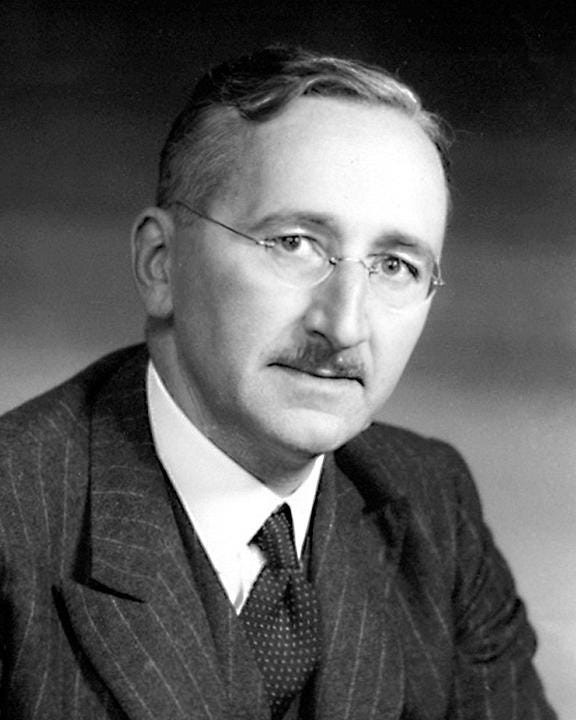
The intellectual foundations of neoliberalism emerged from The Mont Pèlerin Society and similar circles of scholars who critiqued state power in the aftermath of the First World War through mid-20th century. These thinkers sought to counter what they saw as the coercive and paternalistic tendencies of the welfare state. As their meeting minutes from 1947 offered, their central concern was that Western societies were witnessing a fundamental shift away towards repression of individual freedoms:
We are perhaps witnessing a fundamental change in our basic beliefs. The virtues of individual freedom no longer command the support they once did. Order, security, and a fixed status in life are now the prevailing objectives. From this point of view, the free competitive market is indicted and abandoned because it does its task too well and thus yields results incompatible with our moral values.1
Be it liberal democracies, Stalinism, or autocracy, these early neoliberal thinkers proposed that institutional mechanisms must liberate markets from state intervention to foster individual freedom and prosperity. The vision was of rational actors navigating and disciplining themselves within an expansive market sphere, taking full responsibility for both success and failure. Ever astute, Michel Foucault, lecturing on biopolitics in the late 1970s, identified two distinct versions emerging: Austro-German Ordoliberalism and the Anglo-American school. While Ordoliberalism maintained that social concerns should limit market logic, the Anglo-American version sought to apply market rationality to every human faculty and institution. The Anglo-American school, which dominates today’s neoliberal landscape, confronted the perceived failures of liberalism by promoting choice and deregulation. Its core belief in market efficiency drove efforts to reorder institutional and personal spaces around economic principles. This required restructuring the relationship between citizens and government.
However, these ideas remained marginal until the 1970s. Economic and social crises created the conditions for neoliberal thinking to gain traction in liberal democracies. The most notable examples come from Chile and Argentina, where military and economic power toppled governments, but also out of the political movements of Reagan and Thatcher. The Reagan and Thatcher administrations of the 1980s marked neoliberalism’s transformation from theory to political practice. Not without bloodshed, nor chicanery, as David Harvey writes in a A Brief History of Neoliberalism:
How then did neoliberalism negotiate the turn to so comprehensively displace embedded liberalism? In some instances, the answer largely lies in the use of force (either military as in Chile or financial as through the operations of the International Monetary Fund in Mozambique or the Philippines. Coercion can produce a fatalistic, even abject, acceptance of the idea that there was and is, as Margaret Thatcher kept insisting, “no alternative.
Such a drastic shift was not without problems, however. Housing markets in Britain, for instance, caused considerable pricing and availability problems after privatization. National Rail, too, began a structured selling off, while the prized National Health Service barely survives, and hobbles along today. In the United States, deregulation and tax cuts in the guise of fiscal reforms, created competition between municipalities for dwindling funds and prized corporate headquarters and factories. In this “roll-out” phase lasting from the early 80s through the Clinton era, sweeping policy changes meant to unleash competition and wealth via a reduction of government interventionism. Tax cuts encouraged the privatization of public goods and services. National governments were deliberately scaled back while local governments, facing fiscal pressures, scrambled for dwindling resources and entered various arrangements to attract capital.
This market-disciplinary restructuring spread globally, though it varied by nation. Despite differences in implementation, the central vision of economic primacy within a minimalist state achieved remarkable dominance. Policy changes embedded neoliberalism within subsequent administrations by elevating business-minded planning and privatization.
The Evolution: From Roll-Back to Roll-Out
By the 1990s, internal contradictions emerged. The dismantling of centralized agencies and the resulting resource competition produced significant socioeconomic turbulence. Government failures associated with these reforms demanded new solutions. Rather than abandon neoliberalism entirely, governments sought to reform and “roll out” an updated version. This turbulence sparked the proliferation of networks seeking the sharing of resources, fiscal or otherwise. Local governments partnered with big business. Voluntary associations formed alliances with local agencies. Organizations pooled resources independently of government control to stave off competition and diversify risk. These networks, governed by formal and informal linkages, bridged the gap between state and market. However, coordination remained a problem. The state’s role evolved from deregulation and a hands off approach to steering and regulating these networks. Through what some scholars call “the great turn,” the state reconstituted itself as a market-empowering apparatus keeping neoliberal ideology healthy. Rather than commanding, it now coordinates diverse agents toward market-oriented objectives.
Contemporary neoliberal governance operates as a coordinating mechanism aligning state and civil society institutions with free-market principles. It reshapes citizenship itself, positioning individuals as investors or consumers within market logic. State agencies now operate through self-organizing arrangements comprising bureaucrats, private enterprises, nonprofits, community organizations, and citizens themselves. The distinction between public and private sectors has blurred, fundamentally altering power relations between state and civil society. This governance model promotes entrepreneurialism throughout society—encouraging all actors to be independently active and willing to take risks. It constructs links between functioning networks while maintaining the flexibility to assimilate external practices that improve outcomes. Networks of actors regulate social behavior, conjoin government with non-government stakeholders, and involve beneficiaries in coordination processes.
The COVID-19 pandemic illustrated these dynamics in practice. South Korea’s containment strategy, for instance, involved multiple actors and co-directors—including citizens and civil society—working with public agencies. The government constructed new disaster partnerships for childcare, facilitated financial support, and created interdisciplinary expert committees. This wasn’t an abandonment of neoliberal governance but rather its successful assimilation of new ideas and practices to enhance effectiveness without changing its core identity. This adaptability helps explain neoliberalism’s enduring global presence. By maintaining market empowerment as its foundation while absorbing heterogeneous elements, neoliberal governance has proven remarkably resilient across diverse contexts and challenges.
Stormy Weather, Abandoning Capitalism, & Embracing Neofascism
Poignantly, I return to Harvey; “values of individual freedom and social justice are not, however, necessarily compatible.” Contemporary scholarship and political debate increasingly argue that neoliberalism has entered its own end‑game—abandoning capitalism and liberal democracy in favor of a regime of unfettered market dominance that rejects any form of regulation. As several writers observe, this trajectory points towards one of the earliest fears of neoliberal thinkers - authoritarianism. The nature of the authoritarian swing, however, seems to point towards kleptocracy and oligarchy, and in its final stage neofascism, through three converging problems stemming from neoliberalism.
First, the freedom of the individual at the heart of early neoliberal though that, in the words of Henry Maher, “led particular thinkers and political actors to believe that fascism is compatible with neoliberalism [due to] a belief that socialism had to be opposed by all possible means, including violence and the repression of popular democracy…” Socialism, or any other -ism seeking to contest liberty through market, is penned as an ill and moral failing of a society rather than a response to the injustices of the de-regulatory crusade of neoliberalism.
The second is the growing wealth disparity exploding in liberal democracies without social safety nets. As Han describes:
As wealth inequality intensifies, it significantly reshapes class identities, influencing attitudes towards democracy. Both the subjective lower and upper classes exhibit diminished support for democratic systems, albeit for different reasons, which may pose risks to democratic stability. In contrast, the subjective middle class, a stronghold of democratic values, is shrinking in both proportion and influence as wealth inequality widens, potentially weakening democratic institutions further.
Third, political upheavel as governance falters under the weight of the first two leads to a power vacuum easily exploited by elite actors. For contemporary examples, the transition from the Soviet Union to the Russian Federation and the post‑reunification integration of East Germany via the Treuhandanstalt. In Russia, neofascism emerged from the kleptocratic policies of Yeltsin and the later cult of personality built around Vladimir Putin. In Germany, the resulting economic marginalization of the many has led to lasting resentment in the former East Germany, now the base of support for the populist party the AfD. appears to have pushed those left behind by rapid market reforms toward the nationalist and populist currents we see today. Unrestrained neoliberal finance can manufacture crises, depress asset values, and then appropriate those assets. In doing so, neoliberalism reshapes “freedom for the many” into “freedom for the few.”
When such an oligarchy is threatened, oligarchy is supplanted by neofascism through states of exception. Abolishing civil liberties under the banner of national security, branding entire groups as traitors and enemies. Meanwhile, an ever‑wealthier elite safeguards its gains through media control, union‑busting, and regulatory capture, birthing a new—and perilous—world order. We witness these dynamics playing out in Hungary, and Turkey. Nearly successful in Brazil. Now afflicting the United States. As the philosopher and theorist William Connolly observes in his work, Stormy Weather, “much more needs to be explored about this shift…even as we struggle to respond to the death flight of capitalism.”
Many of the society records can be found via the Hoover Institute at Standford https://digitalcollections.hoover.org/objects/185/mont-pelerin-society-records